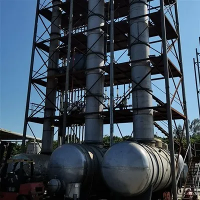
Heat exchangers are widely used in the oil refining industry, and their importance is self-evident. The utilization rate of heat exchange equipment directly affects the efficiency and cost of the oil refining process. Statistics show that heat exchangers account for approximately one-fifth of the investment in chemical engineering projects. Therefore, the utilization rate and lifespan of heat exchangers are important issues worthy of study. Corrosion is a significant cause of heat exchanger damage, and it is widespread and prevalent. Solving the corrosion problem is equivalent to solving the root cause of heat exchanger damage.
1. Corrosion Inhibitors Corrosion inhibitors with chromate as the main component are commonly used in cooling water systems. Chromate ions are an anodic (process) inhibitor, and when combined with suitable cathodic inhibitors, they can achieve satisfactory and economical corrosion protection.
Chromate-Zinc-Polyphosphate: Polyphosphates are used because they clean metal surfaces and have corrosion inhibition capabilities. Polyphosphates can partially convert to orthophosphates, and they can also form large colloidal cations with calcium, inhibiting cathodic processes.
Chromate-Zinc-Phosphonate: This method, similar to the previous one, uses sodium phosphonate instead of polyphosphate. Aminomethylimide phosphate can also be used in situations where the pH value is higher than that specified for polyphosphate. Aminomethylimide phosphonates can prevent scale formation and control calcium salt precipitation even at pH 9.
Chromate-Zinc-Hydrolyzed Polyacrylamide: The dispersing effect of hydrolyzed polyacrylamide, a cationic copolymer, can prevent or inhibit scale and fouling formation.
2. Electrochemical Protection: Cathodic and anodic protection are employed. Cathodic protection uses an external DC power supply to make the metal surface cathode, resulting in high power consumption and cost. Anodic protection connects the heat exchanger to the anode of an external power supply, causing a passivation film to form on the metal surface, thus providing protection.