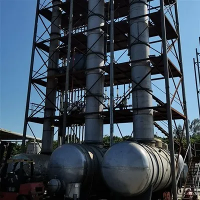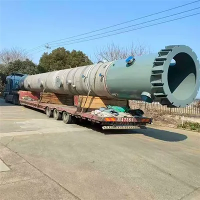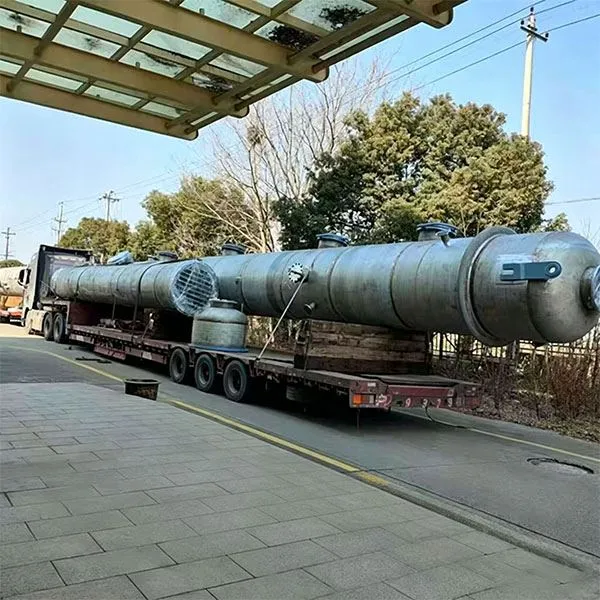

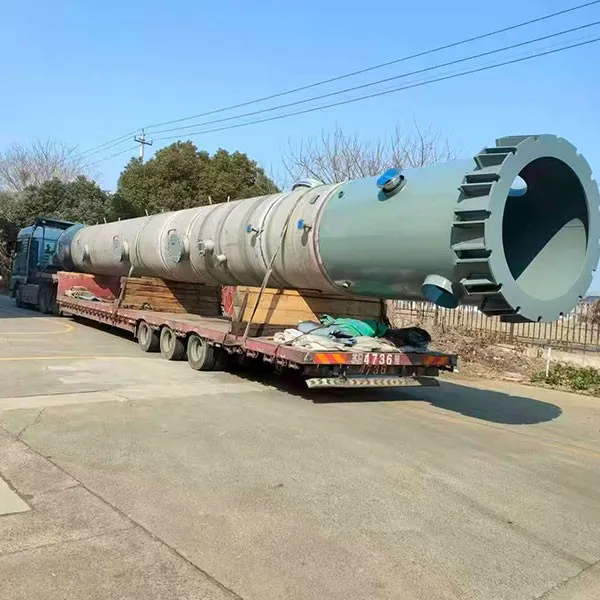
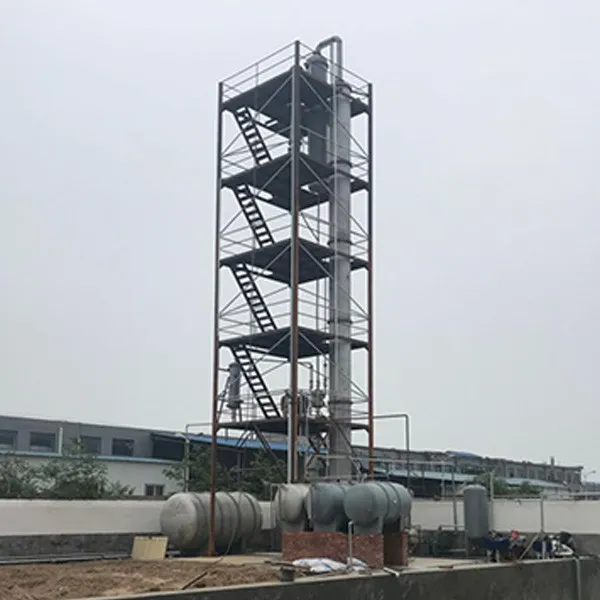
This acrylic distillation system is specifically designed for the refining and purification of crude methyl methacrylate (MMA) monomers produced from the cracking of waste acrylic. It is a core refining device in the MMA resource recycling industry chain. Utilizing a continuous / batch distillation process, it achieves efficient separation based on the difference in boiling points of the components, removing moisture, light component impurities, heavy component tar, and incompletely cracked polymers from the crude MMA. The final product is high-purity MMA monomer, meeting the raw material purity requirements of downstream processes such as acrylic recycling granulation and sheet production.
Key Technical Parameters
The petroleum distillation column is suitable for crude MMA monomer (purity ≥88%); operating pressure: atmospheric pressure to negative pressure (-0.08~0.1MPa); distillation temperature: 60~105℃; throughput: 0.3~12t/d; product MMA purity ≥99.5%; wetted materials primarily: 316L stainless steel, PTFE, avoiding contact with carbon steel; explosion-proof rating: Ex d IIB T4 Gb and above; protection rating: IP65; equipped with vacuum unit, condensate recovery, temperature control and anti-polymerization protection system, complying with chemical safety and environmental emission standards.
Installation Instructions
Pre-Installation Preparation
Equipment Verification
Confirm that the model, capacity, material, and pressure rating of the entire set of components, including the distillation column, reboiler, condenser, vacuum unit, feed pump, and control system, match the on-site process. Check that the column body, heat exchanger, and pipelines are free from deformation or damage; that the gaskets (high-temperature resistant fluororubber, graphite gaskets) are intact; and that instruments, valves, and electrical components are undamaged and that all accessories are complete and in order.
Tools and Materials
Prepare explosion-proof wrenches, levels, multimeters, vacuum gauges, 316L flanges, high-temperature and corrosion-resistant gaskets, explosion-proof cables, grounding wires, and hoisting equipment. All tools must comply with chemical explosion-proof standards, and pipeline fittings must be compatible with negative pressure and MMA media characteristics.
Site Survey
The installation area is a safe chemical production area, far from open flames, static interference sources, and residential areas. The ground is flat and meets load-bearing standards, with sufficient space (≥1.5m) for operation, maintenance, and inspection. It has a stable three-phase power supply, circulating cooling water, and nitrogen gas supply, good ventilation, and is equipped with fire protection and combustible gas alarm facilities. The pipeline layout facilitates feeding, discharging, reflux, sewage discharge, and vacuum connection.
Installation and Operation Points
Main Equipment Fixing
Core equipment such as the distillation column, reboiler, and condenser are hoisted into place. Fine-tune the horizontal and vertical alignment (vertical deviation ≤1‰). Securely tighten anchor bolts. Ensure coaxial connections between equipment, avoiding forced connections that could cause stress damage. Maintain a safe distance between the equipment and walls/ground for heat dissipation.
Auxiliary System Connections
Connections are made to the circulating cooling water system, vacuum unit, nitrogen purging system, and condensate recovery system, ensuring smooth cooling circulation, stable vacuum, and proper nitrogen purging. Flame arresters, safety valves, and other safety accessories are installed according to specifications and are effective.
Piping System Connections
The feed pipe, distillate outlet pipe, residual liquid discharge pipe, reflux pipe, vacuum pipeline, and cooling water pipe are all made of 316L stainless steel. Flange connections are fitted with dedicated sealing gaskets, and bolts are tightened evenly to prevent leaks. Vacuum pipelines are tightly sealed with no leaks. Process pipelines are designed with a reasonable slope to facilitate liquid drainage and material flow, preventing residue from causing MMA polymerization.
Electrical and Instrumentation Installation
Connections are made to the electric heating reboiler, vacuum unit, and control system wiring. Explosion-proof sealing and grounding are ensured, with grounding resistance ≤4Ω and insulation resistance ≥20MΩ. Temperature sensors, pressure transmitters, level gauges, flow meters, and other instruments are installed, calibrated, and securely fixed. Instrument displays are clear for easy on-site observation and remote monitoring.
Installation and Acceptance
After the crude distillation column is installed, it will undergo phased acceptance. Only after passing these steps can the commissioning phase begin:
Mechanical acceptance
Check that the equipment is securely fixed, pipeline connections are standardized, seals are leak-free, and valves open and close flexibly.
Electrical instrumentation acceptance
Confirm that explosion-proof wiring is compliant, grounding is qualified, and instrument displays are accurate.
Negative pressure airtightness test
Evacuate the system to -0.08MPa, hold the pressure for 30 minutes, and the pressure recovery value meets the standard.
No-load power-on test
Check that auxiliary equipment and control system operate normally, with no abnormal alarms.
Commissioning Method
No-load Commissioning
After successful installation and acceptance, without adding crude MMA material, first start the circulating cooling water and vacuum unit to test that the system vacuum level meets the standard and is stable; start the reboiler for no-load heating, check that the temperature control system is responsive and the temperature adjustment is accurate; test that the instrument data transmission, alarm devices, and automatic reflux system function normally, that all auxiliary equipment operates smoothly, and that there are no leaks, abnormal noises, or overheating. After one hour of no-load operation without abnormalities, prepare for load commissioning.


Load Commissioning
Feed the pretreated crude MMA material at a small flow rate, start the feed pump, and gradually adjust the feed rate, reboiler heating temperature, vacuum degree, and reflux ratio, strictly controlling the distillation temperature within the range of 60~105℃; observe the distillation state and reflux effect within the column, and periodically sample and test the purity, moisture content, and impurity content of the refined MMA; gradually optimize process parameters, adjusting the feed rate, reflux ratio, and vacuum degree until the purity of the refined MMA is stably ≥99.5%, the residual liquid discharge meets the standard, the system operates smoothly, and there is no tail gas leakage.
Parameter Calibration and Consolidation
After successful commissioning, calibrate all instruments such as temperature, pressure, flow rate, and liquid level, lock in the optimal process parameters, and enter them into the control system; test the automatic control, over-temperature and over-pressure alarms, and emergency shutdown functions to ensure that all protection mechanisms are sensitive and effective; record all commissioning parameters to form a process operation manual as the standard basis for daily operation.
Daily Maintenance and Care
Monitor key parameters such as system vacuum, distillation temperature, feed rate, reflux rate, and discharge purity in real time to ensure they meet set values; check the sealing of the tower body, pipelines, valves, and heat exchangers for MMA leaks, abnormal vibrations, and unusual noises; observe the heating effect of the reboiler and the cooling effect of the condenser, ensuring the circulating water flow and temperature are normal; check that instrument data is normal and alarm devices have no false alarms; clean surface stains on equipment, check for liquid accumulation and blockages in pipelines, and maintain accurate operation records.
Monthly Maintenance: Check the flexibility of all valve opening and closing, and replace aged gaskets; clean the feed filter and condenser heat exchange surfaces to remove impurities and deposits; calibrate key instruments, and tighten loose terminals and pipeline flanges; check the vacuum unit oil level, replace aged vacuum pump oil, and ensure stable vacuum levels.
Quarterly Maintenance: Conduct partial inspections of the distillation column, reboiler, and reflux tank, cleaning any minor residual polymers and impurities from the inner walls; inspect pipelines for corrosion and wear, repairing minor defects; test the response accuracy of the automatic control system and optimize parameter adaptability; comprehensively check safety accessories, ensuring safety valves, flame arresters, and explosion-proof membranes are intact and effective.
Annual Maintenance: After the system is shut down and cooled, conduct a complete disassembly and overhaul, cleaning the column packing, reboiler, condenser, and all pipelines; replace easily worn parts such as gaskets, filters, and vacuum pump oil; inspect the equipment for corrosion and deformation, and perform anti-corrosion maintenance; comprehensively calibrate all instruments and control systems, conducting airtightness and negative pressure tests, and only restart operation after passing these tests.
MMA monomers are prone to polymerization, making this a key maintenance focus: After system shutdown, immediately purge the column, pipelines, and heat exchangers with nitrogen to remove residual MMA material; for long-term shutdowns, periodic nitrogen purging is necessary to prevent air ingress and polymerization; during operation, strictly control the temperature, prohibiting overheating, and add polymerization inhibitors as needed; if slight polymerization deposits are found, clean them promptly with a dedicated solvent to prevent polymer buildup and blockage of trays, pipelines, and heat exchangers, which would affect distillation efficiency.
Common Fault Diagnosis and Handling
|
Fault Phenomenon |
Possible Cause |
Handling Method |
|
MMA Purity Not up to standard |
Excessive feed rate, reflux ratio imbalance, abnormal vacuum, temperature deviation, blockage inside the tower |
Adjust feed rate, optimize reflux ratio, calibrate vacuum unit and temperature control system, clean blockages. |
|
Insufficient system vacuum / inability to maintain pressure |
Vacuum pipeline leakage, vacuum pump failure, aging gaskets, valve not closing tightly |
Inspect and plug leaks, repair vacuum pump, replace aging gaskets, tighten valves and flanges. |
|
Equipment / Pipeline Leakage |
Aging seals, loose flanges, pipeline corrosion and damage, valve core damage |
Shut down and depressurize, replace seals, tighten flanges, repair or replace damaged pipelines and valves. |
|
Blockage inside the tower / pipeline |
MMA agglomeration, material impurity accumulation, untimely residual liquid discharge |
Shut down and cool down, nitrogen purging + special solvent cleaning, strengthen material pretreatment, regular sludge removal. |
|
Slow reboiler heating / overheating |
Damaged heating element, temperature control failure, severe scaling, abnormal voltage |
Inspect heating components, calibrate the temperature control system, clean reboiler scale, and check power supply stability. |
|
Instrument display abnormalities / out of control |
Sensor failure, loose wiring, uncalibrated instruments, control system failure |
Tighten wiring, replace damaged sensors, recalibrate instruments, and repair the control system. |
Safety Precautions

This Distillation Column Systems is explosion-proof chemical equipment. Operators, installers, and maintenance personnel must be professionally trained and certified, and wear anti-static, anti-corrosion, and high-temperature resistant protective equipment at all times. Unauthorized operation is strictly prohibited.
Use explosion-proof tools throughout the operation. Open flames, static electricity, and sparks are strictly prohibited on site. Maintain forced ventilation and equip the system with combustible gas alarm devices and fire extinguishers to prevent the accumulation of MMA vapor and the risk of combustion and explosion.
During system operation, it is strictly forbidden to arbitrarily change core parameters such as distillation temperature, vacuum, and reflux ratio. Over-temperature, over-pressure, and overload operation are strictly prohibited. In case of leakage, over-temperature, alarms, or other abnormalities, immediately shut down the system.
Before any maintenance work, the machine must be shut down, power disconnected, pressure released, and temperature cooled. The system must be thoroughly purged with nitrogen to remove any residual MMA material. A work permit must be obtained before commencing work. Live maintenance must be performed by a certified electrician.
Crude MMA material must be filtered to remove impurities beforehand. Metal and polymer lumps are strictly prohibited from entering the system and damaging internal components. Polymer inhibitors and cleaning solvents must be managed according to hazardous waste regulations, with unified recycling and disposal; arbitrary discharge is prohibited.
Regularly inspect safety valves, flame arresters, explosion-proof membranes, and other safety accessories to ensure they are in good working order. Non-professionals are strictly prohibited from disassembling equipment or modifying the control system and piping.
Disclaimer
This system must be installed, commissioned, operated, and maintained strictly in accordance with this manual and relevant chemical safety regulations. The manufacturer is not liable for equipment damage, safety accidents, or quality problems caused by improper operation, unauthorized modifications, substandard materials, or improper maintenance.
During the equipment warranty period, the manufacturer provides free repair and parts replacement for quality problems not caused by human error. Beyond the warranty period, the manufacturer provides paid after-sales service, parts supply, and technical guidance. The manufacturer is not liable for system damage caused by force majeure, unsuitable on-site conditions, or malfunctions of third-party equipment. Users must strictly adhere to process requirements and use compatible upstream pyrolysis and downstream storage equipment to ensure overall process stability.
After-sales advice: If equipment malfunctions, please contact professional repair personnel. Do not attempt to disassemble core components yourself to avoid personal injury and further damage to the equipment.
Hot Tags: industrial distillation column, China industrial distillation column manufacturers, suppliers, factory